Environmental Product Declarations (EPDs) are becoming increasingly important in the construction sector. As sustainability targets become more ambitious and assessment methods such as the MPG gain importance, the demand for reliable environmental data for material selection continues to grow.
Yet for flooring systems, an EPD for a single product does not provide the full picture.
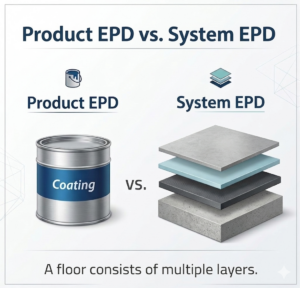
A resin flooring system consists of multiple layers, such as a bonding layer, scratch coat, resin layer and topcoat. Together, these determine both the final performance and the environmental impact of the floor. Anyone who wants to assess the impact of a floor properly must therefore look beyond product level alone.
That is why EPI chooses not only product EPDs, but also EPDs for complete flooring systems. This creates a more realistic view of the floor as it is actually applied in a project.
Many EPDs on the market are prepared for individual products. That information is valuable, but it only tells part of the story.
In practice, a floor is not built up from a single product, but from multiple products that together form a complete flooring system. A system EPD calculates the environmental impact of the full floor build-up per square metre, including all layers required to realise the system.
This makes system EPDs more relevant for design, specification and sustainability assessments. The focus is not on the impact of one single component, but on that of the complete flooring solution.
Not only the system boundary matters, but also the quality of the underlying data.
Many EPDs on the market are model EPDs, based on generic formulations and industry averages. While these can be useful as a reference, they do not always say enough about the actual environmental performance of a specific product within a flooring system.
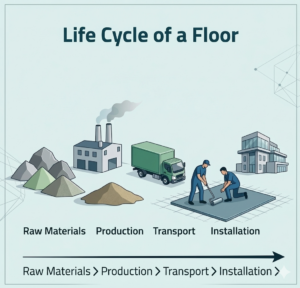
That is why EPI deliberately chooses product-specific data, based on externally verified data for each raw material and each product. For EPI’s EPDs, raw materials, production processes and transport flows have been analysed separately for each product in a Life Cycle Assessment. This creates an objective, product-specific basis for the system EPDs, rather than a generic picture based on averages.
These product-specific analyses also form the basis of the system EPDs. As a result, a more realistic and better substantiated overall picture is created of the environmental performance of the complete flooring system.
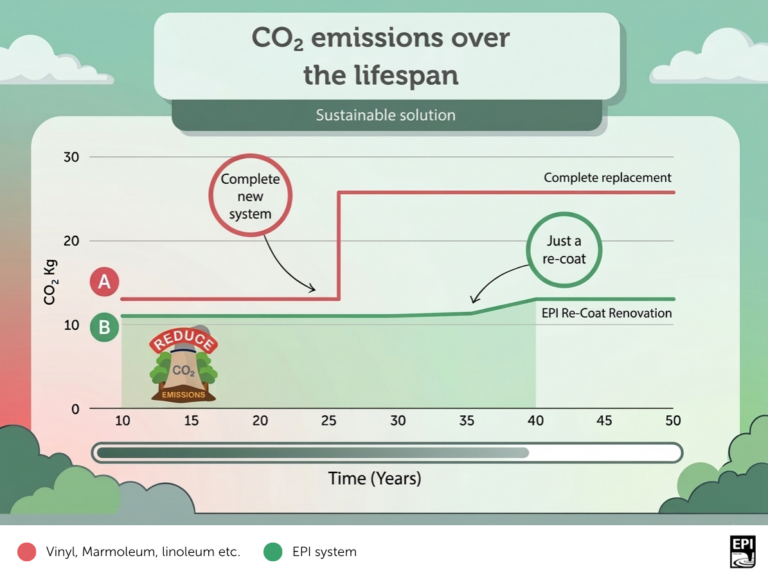
The environmental performance of a floor is not determined by its initial production impact alone. Maintenance, renovation and replacement also play an important role in the total impact over its full service life.
In the short term, flooring systems may appear comparable. Over a longer period, however, a different picture often emerges, for example when only a topcoat needs to be renewed while the base layer remains in place.
That is precisely why assessing the full service life is essential for a fair comparison between flooring solutions.
In the Netherlands, the environmental performance of buildings is increasingly assessed at building level, for example within the MPG methodology. In that context, it is important that environmental data closely matches the actual application of materials in a project.
When data is available at system level, it provides a picture that better reflects the floor build-up as it is actually realised. This makes system EPDs not only more transparent, but also more practical in use.
With EPDs for complete resin flooring systems, EPI aims to contribute to greater transparency in the construction sector. Not only at product level, but specifically at system level.
For architects, consultants and clients, this means better substantiated environmental data and a more realistic basis for making sustainable material choices.
Would you like to know which EPD data is available for your project, specification or sustainability assessment? Please contact EPI. We are happy to think along with you about the environmental performance of complete flooring systems within your project.
Email us at sales@epigroup.nl.